Who’s Responsible When a Neighbor’s Tree Falls on Your Car?
 Written by
Christine Lacagnina has written thousands of insurance-based articles for TrustedChoice.com by authoring consumable, understandable content.
 Reviewed by
Cara Carlone is a licensed P&C agent with 20 years of experience. She has her P&C license in RI and TX and holds CPCU, API, and AINS designations.
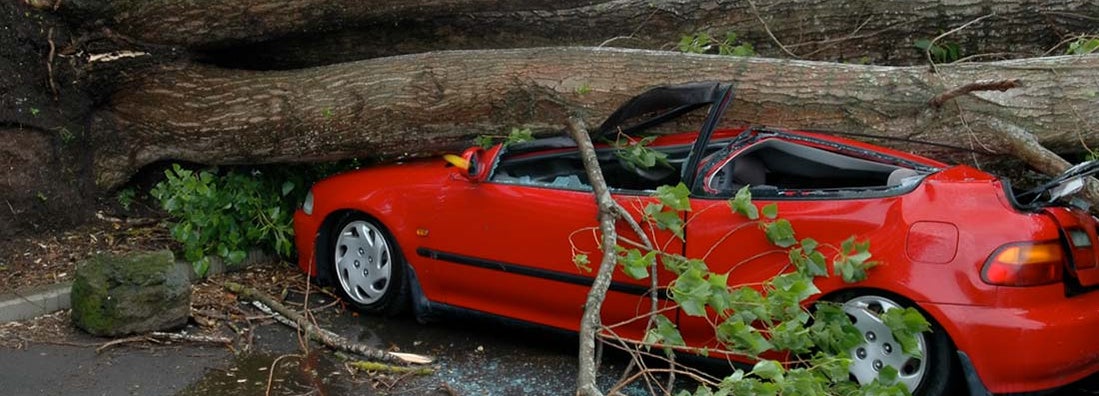
There are some disasters you just can't prevent at your home, such as pieces of your neighbor's property falling over and smashing yours. So if your car was parked in your driveway and a neighbor's tree fell on it, who would be responsible for the damage? Knowing which insurance policy to go through can help streamline the process of getting the reimbursement you deserve.
While an independent insurance agent can help you get set up with the right type of car insurance for this situation, we can start by helping to answer this question. Here's a deep dive into who'd be responsible if a neighbor's tree fell down during a storm and landed on your car.
Who’s Responsible If a Neighbor’s Tree Falls on My Car During a Storm?
Technically, no one's really responsible for storms and the damage they cause. However, someone still has to file an insurance claim when your car gets smashed. So unless you could somehow prove that your neighbor's negligence caused the tree to fall, which is unlikely, you'd probably file a claim through your own insurance.
Since your homeowners insurance probably wouldn't cover your smashed car in this scenario, you'd need to have a certain kind of car insurance. Falling objects and storm damage both require a specific type of car insurance known as comprehensive coverage, or other than collision coverage. If you had comprehensive car insurance in this situation, your independent insurance agent could help you file a claim and walk you through the whole process.
Will My Car Insurance Fully Cover the Damage to My Car?
As long as you have comprehensive car insurance, your vehicle's damage would be covered up to the actual cash value or the replacement cost of the car if the claim was approved by your carrier. You'd have to pay the deductible amount out of your own pocket before receiving reimbursement, however. You can adjust your car insurance limits and deductibles with the help of your independent insurance agent before an incident occurs if you're concerned about how much you might have to pay out of pocket.
What Does Car Insurance Cover?
All states have their own minimum car insurance requirements, but most states require drivers to have at least both kinds of liability insurance. In addition to comprehensive coverage, which pays for damage to your car due to a non-collision event such as a flood or theft, many drivers also choose the following coverages when building their car insurance policies:
- Uninsured motorist coverage: This coverage protects you if you get into an accident with a driver who does not carry any or enough car insurance to reimburse you properly or if you're the victim of a hit-and-run.
- Bodily injury and property damage liability: This coverage reimburses you for medical costs to other drivers and their passengers if you get into an accident, and for repair costs to any property you damage with your vehicle, such as buildings.
- Collision coverage: This coverage pays for damage to your car from a collision with another object, regardless of fault.
- Personal injury protection: This coverage pays for the driver’s injuries and injuries to their passengers after an accident. It can also cover lost wages and other related expenses. PIP coverage is not available in all states.
- Medical payments coverage: This coverage pays for medical expenses for the driver's injuries and their passengers' injuries after an accident.
Your independent insurance agent can also help you assemble a car insurance policy that will reimburse you for damage resulting from falling trees from your neighbor's property and much more.

Save on Car Insurance
Our independent agents shop around to find you the best coverage.
What If I Don't Have Comprehensive Coverage?
Normally, you'd file a claim for this type of incident through your own car insurance policy, unless you didn't have comprehensive coverage. Without comprehensive coverage, your car insurance likely won't cover this kind of claim. But your personal homeowners insurance is unlikely to cover the incident either way.
Do I Have to Pay the Full Amount of Damage If I Don’t Have the Right Coverage?
If you have comprehensive coverage, you'd only be responsible for covering the amount of the deductible and any damage exceeding your policy's limits as long as your claim was approved. So, if the total damage amount was less than your car insurance's limit and your deductible was $500, you'd pay the $500 and the remainder would be covered by your policy.
Really, there shouldn't be a case in which you'd have to pay for all the damage to your vehicle out of your own pocket if it got smashed by your neighbor's tree during a storm. However, there can be more complicated scenarios if your neighbor takes legal action.
What If the Neighbor Was Trimming a Tree Branch and It Fell on My Car?
If your neighbor was trimming their tree, which caused a branch to fall on your car, then it was no longer an act of nature, and you could more easily assign responsibility. But you could still file a claim through your own comprehensive auto insurance for the fallen object. Another option would be to get reimbursement through your neighbor's homeowners liability insurance since they were technically responsible for the incident.
5 Steps to Take If a Tree Falls on Your Car
Say a tree does fall on your car. No matter the exact scenario or who was responsible, there are a several steps you should always take. Follow this simple guide if you ever find yourself in this situation:
- Contact your agent: You should let your independent insurance agent know about the incident right away. They can advise on which type of coverage would pay for the damage and how to proceed.
- Take photos: Get some photos of both the fallen tree or branch and the parts of your car it damaged. You'll need these to submit to insurance and keep them for your personal records.
- Clear the mess: Take care of any debris that may still be on your car or in your driveway, assuming you can do this safely and without causing any more damage.
- Review your coverage: Have a look at the damage and your insurance policy's deductible amount. If the potential damage is less than your deductible or close enough, you may not want to file a claim.
- File a claim: If the damage is enough to warrant filing a claim, get a hold of your independent insurance agent to start the process and get your car back on the road.
Your independent insurance agent can also help advise if the extent of the damage to your vehicle warrants filing a claim at all. Sometimes, when damage is minimal and doesn't exceed your deductible, it's easiest to avoid the hassle because you'd have to pay the damage out of pocket anyway. But since these unexpected incidents happen more frequently than you might expect, consider speaking with your independent insurance agent about adding comprehensive coverage to your car insurance if you don't have it already.
Why Choose an Independent Insurance Agent?
When you're ready to get equipped with the right comprehensive car insurance, no one's better prepared to help than local independent insurance agents. These agents have access to multiple car insurance carriers, so they can shop and compare rates for you. They'll get you set up with the right coverage at the best possible rate. And down the road, your agent will still be there to help you file car insurance claims when necessary.
https://www.iii.org/article/what-is-covered-by-collision-and-comprehensive-auto-insurance