
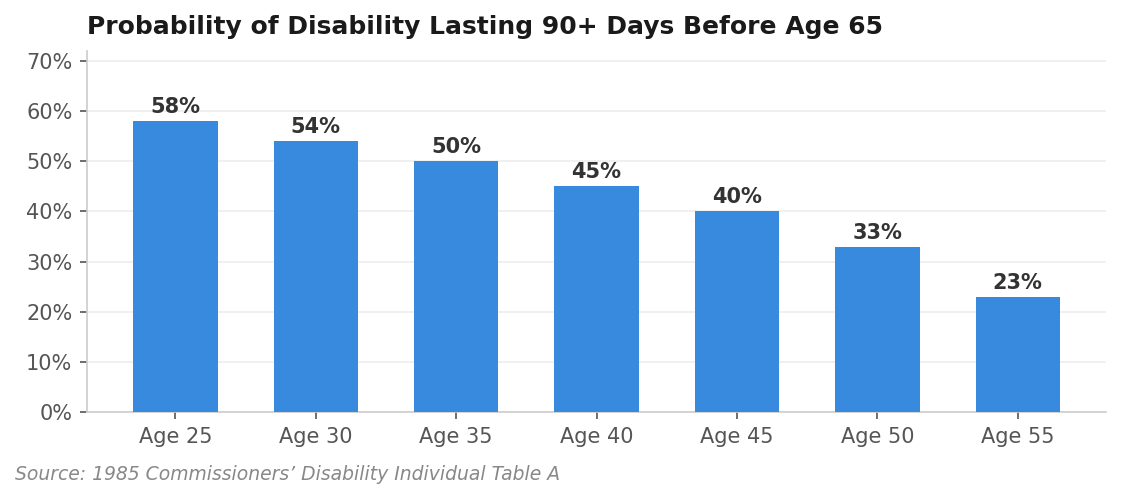
When it comes to creating a financial foundation, most people focus on life insurance. However, if you stop there, you have missed another peril that statistically is more likely to happen before age 65 than dying: becoming disabled for an extended period of time.
Here’s an illustration of the reality of the threat.
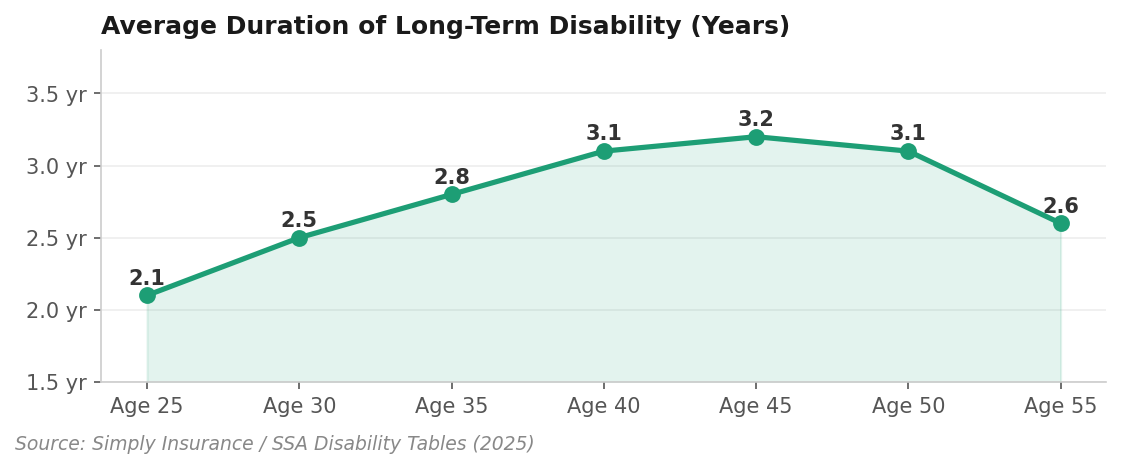
Note that the average duration of long-term disability (more than 90 days) increases until age 50 but is still significant past age 50. Imagine going without a paycheck for this period of time.
There is no more recent table that is used for consumer facing data on the probability of a disability lasting 90 days or longer before age 65, which is why the 1985 table still dominates consumer-facing materials. Every major disability insurance resource — the Council for Disability Awareness, LIMRA, Guardian, Simply Insurance, and others — continues to cite the 1985 Commissioners' Disability Individual Table A as the source for the age-based probability statistics.
A 2024 study by LIMRA indicates that fewer than one in five are covered by a long-term disability policy. Why is disability coverage overlooked? There are several reasons:
-
Lack of understanding of the likelihood of experiencing a long-term disability
-
Belief that Social Security provides adequate protection
-
The perceived cost
-
Assumption that their employer provides it
Definitions matter: Own occupation vs. any occupation
When insurance sold online like a simple commodity, consumers can lose sight that an insurance policy is a contract they enter into with an insurance company. The policyholder agrees to pay the scheduled premiums and the insurance company agrees to provide the policy benefits stated in the contract. This is why it is difficult to make an apples-to-apples comparisons among disability policies. The starting point is to understand that the most important aspects of a long-term disability policy are the way disability is defined relative to your specific ability to work and the duration of the disability benefit.
The objective for purchasing a disability insurance policy is to safeguard the income you earn based on your skills and experience. To accomplish this, your disability policy should use a definition of disability that is based on your ability to perform the material and substantial duties of your own occupation. This definition of disability is referred to “own occupation.”
The other definition of disability is the inability to perform “any occupation.” This broader definition means you will be deemed disabled only if you are unable to perform the duties of any gainful occupation for which you are reasonably suited by education, training or experience. For example, consider a professional with unique skills like a commercial airline pilot, who develops a medical condition that no longer allows her to fly. She could provide classroom instruction and would not be considered disabled under an “any occupation” definition. Under an own occupation definition, the pilot would qualify for disability under the policy.
The other major policy consideration is how long will the disability insurance benefit be paid if the insured remains disabled. Most individual disability insurance policies provide benefits until age 65 or age 67. However, some policies provide disability benefits based on the own occupation definition for the first two years, then apply the any occupation definition for the remainder of the policy period. This is an enormous distinction because payments could stop after only two years, even if the person is unable to perform the duties of their profession but would not be deemed disabled under the any occupation standard. (For purposes of receiving Social Security disability benefits, the any occupation standard applies.)
The reality is that if you work in a specialized occupation and want disability income protection even though there is a lesser paying job you could perform, you should look for a policy that has own occupation as the criteria for the duration of the policy. In reviewing options, be sure to ask how the policy classifies your specific occupation to avoid any unpleasant surprises down the road.
How much disability insurance do I need?
The short answer is, “As much as you can get!” But there are two realities:
- Budget considerations, and
- Disability insurance policies typically cap the benefit at 66-2/3% of your current income (which is averaged over two or three years).
The insurance company’s concern is that if 100% of the income was replaced, the insured’s motivation or return to work could be low. In some circumstances, you may be able to negotiate a fixed monthly amount if your income has dipped or you are starting a new business.
The good news is that the tax code provides a way to increase the value of your after-tax disability payments. Under Internal Revenue Code Section 104, if the disability insurance premiums are paid with after-tax dollars by the insured, the benefit when received will be free of federal, state and FICA (Social Security and Medicare) taxes. That represents considerable tax savings, which could range from 20% to as high as 45%. From a take-home pay standpoint, the income-tax-free disability payment could come close to replacing the person’s prior income. This is a worthwhile trade-off for the insured to consider.
A common scenario for a person who is receiving disability benefits — especially using an own occupation definition — is that eventually they may return to work but in a phased manner. To encourage this approach, the disability policy may provide what is referred to as a “residual disability benefit,” which pays a proportional disability benefit to the person returning to the workplace, but whose income is still than lower than their pre-disability income. In this way, they will receive a supplement to their pre-disability earnings. This is a valuable benefit to have as some policies also pay for training, if needed, to facilitate the person’s return to the workforce.
Contrasting individual versus group disability insurance
The two basic ways to obtain disability insurance are by purchasing it individually or having an employer that offers disability insurance. Given the job mobility in today’s economy, when a person takes out an individual disability insurance policy, they have the comfort of knowing that if they change jobs, they are in control of their disability benefits, terms, and conditions, which can be tailored to their needs. They can decide the waiting period for benefits to begin (elimination period), which is usually 60, 90 or 120 days, as well as the definition of disability and length of the policy term.
Disability insurance provided by the employer is a meaningful employee benefit. Yet, there are differences that will be out of the employee’s control such as the maximum benefit, which may only be 60% of base salary (and could exclude bonuses and other payments). Group disability may provide an own occupation definition, but only for the first two years (or not at all), then switch to any occupation. And if you leave your employer, you lose your coverage. Further, your company’s disability insurance policy may offset Social Security Disability Insurance (SSDI) payments so you will not receive the total of both payments.
If your employer does provide disability insurance at no cost, be sure to ask if you can be taxed on the value of disability premiums (indicated on your W-2), otherwise the payments will be fully taxable when received. If you are covered by group disability insurance, you can still take out an individual policy, but the payments may be coordinated with your employer’s policy. An insurance agent that sells disability insurance may be a good resource to discuss how this would work in your case.
Another type of employer-provided disability is short-term disability insurance. It is designed to provide either a portion of your income or stipulated benefits that may start within a week of your disability but will stop typically at the end of 26 weeks. Individual short-term policies can be purchased, which may be prudent for a self-employed person.