How Much Does Group Long-Term Disability Insurance Cost?
Find out how to give your employees the benefits they deserve without breaking the budget.
 Written by
Christine Lacagnina has written thousands of insurance-based articles for TrustedChoice.com by authoring consumable, understandable content.
 Reviewed by
Cara Carlone is a licensed P&C agent with 20 years of experience. She has her P&C license in RI and TX and holds CPCU, API, and AINS designations.

Providing disability insurance for your employees is a great way to protect them and keep them satisfied with their jobs. But how much will offering this benefit cost your company? And how can you get the best price without sacrificing protection?
The good news is that group disability plans don't have to cost much, and an independent insurance agent can help you find affordable coverage. They’ll shop and compare plans from multiple insurance companies and help guide you through all your options. But first, here's a bit of background on long-term group disability insurance costs, including how they're calculated and tips to make sure you get the best price possible.
How Much Does Long-Term Group Disability Insurance Cost?
The average cost of long-term group disability insurance can range from $25 to $500 per month. When it comes to pricing, it's the risk that determines the cost. The riskier your employees' needs, the higher the premiums, and vice versa. Premium costs are calculated by:
- Industry: The insurance company will charge based on the business you're in and the activities of your employees. Employers with only office workers will have a lower rate than employers with office workers and higher-risk positions.
- Demographics: The size, age ranges, gender, and income ranges will affect the rate. Larger groups pay less per employee than smaller groups. Groups that are younger will pay less than groups that are older.
- Location: Different areas of the country experience different claim rates.
- Participation: Plans that are employer-paid or have high participation rates tend to have a better claims experience than groups that have low participation rates.
- Experience: Insurance companies will consider the disability experience of the group if it's large enough.
- Plan design: Plans with more generous benefits have more risk than plans with a more modest design.
The insurance company will adjust the price of the plan premiums annually. Working with a local independent insurance agent is a great way to stay covered with the most affordable policies each year.
Tips to Reduce the Cost of Long-Term Group Disability Insurance
Long-term group disability insurance is a very flexible benefit. Employers offer it voluntarily, so there are no mandated benefits. The cost of the benefit to the employer can be managed in several different ways, including the following.
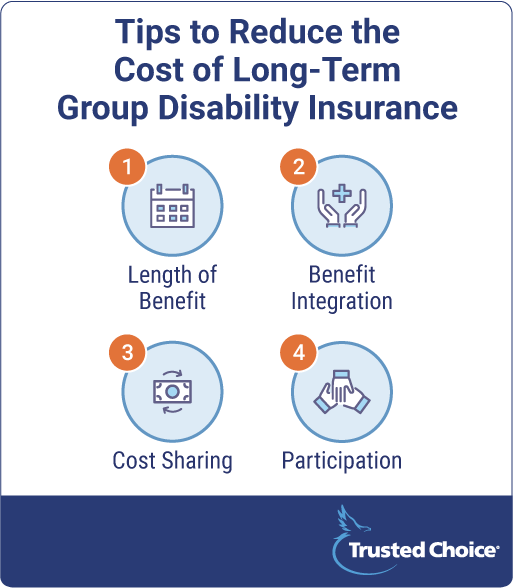
- Length of the benefit: Employers can select benefit periods for long-term disability ranging from two years to five years or 10 years, or policies can cover an employee up to age 65. The longer the benefit, the higher the cost. Employers can also select elimination periods from 30 days to one year or more. The longer the elimination period, the lower the cost.
- Benefit integration: Employers can offset the benefit by any Social Security or workers' compensation payments.
- Cost sharing: Employers can pay all or a portion of the benefits for their employees.
- Participation: Groups with high participation rates will have a lower cost. Employer pay-all plans have lower rates because the participation rate is 100%.
Adjusting any of these factors can influence the cost of an employer's long-term group disability insurance premiums.
Why Offer Long-Term Group Disability Insurance?
The risk of disability during working years is significant. A serious injury or illness can be a challenge for both employees and business owners, as both can stand to lose money.
Along with physical and emotional issues, financial concerns can make recovery more difficult. Business owners have to grapple with pay and workload issues. After sick and vacation time is used up, how long will the employee be paid? Replacing seasoned employees can be costly. A group long-term disability plan can help solve that problem.
Long-term disability plans can help employers manage the difficult human resources problems that arise when an employee is out for an extended time because of illness or injury. Many plans offer additional benefits to assist the employee in returning to work.
Group long-term disability plans are a tool to keep employees. When these plans are offered, it's worth spending time educating employees on the risk of developing a disability. The insurance company usually provides materials to help employees understand how important disability insurance is to their financial and overall health.

Save on Disability Income Insurance
Our independent agents shop around to find you the best coverage.
Voluntary Group Long-Term Disability Plans
Voluntary plans are available for long-term disability benefits. Employees pay the premium and choose to take part. One reason to consider voluntary plans is that the benefits paid are tax-free.
Voluntary plans have no out-of-pocket cost for the employer. The value provided to the employee is easy and inexpensive access to coverage. Voluntary plans can also offer additional flexibility as supplementary long-term coverage above the basic amounts offered.
Group Long-Term Disability Insurance for the Self-Employed
A small business can also offer group long-term disability plans. Small group disability plans are available for as few as two people. These plans have fewer options and fewer benefits, and they may also need some medical and financial information from participants.
Other Added-Value Features to Consider in Your Group Disability Plan
Your company's group long-term disability insurance plan can be customized to offer several types of benefits for employees, including the following.
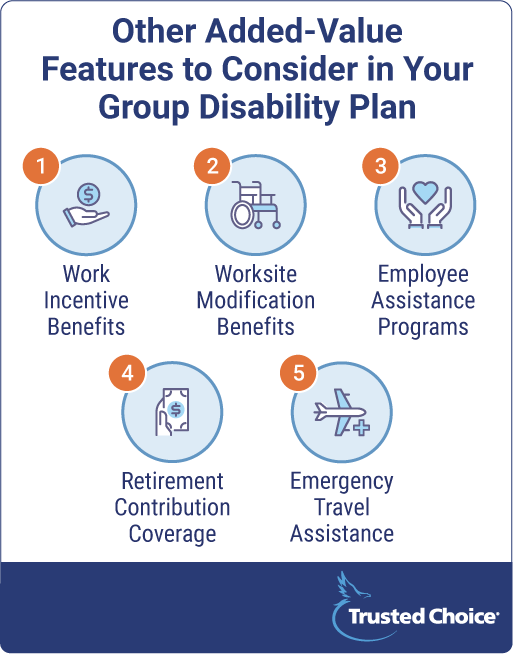
- Work incentive benefits: Work incentive benefits pay more to return to work while participating in a rehabilitation program.
- Worksite modification benefits: This feature pays for modifications of work stations or additional equipment.
- Employee assistance programs: This provides support for employees who may be facing difficult issues, such as family crisis, addictions, and depression.
- Retirement contribution coverage: This pays for contributions to the employer’s retirement plan.
- Emergency travel assistance: This pays for hospital and emergency evacuation while traveling.
Your independent insurance agent can help you customize your group long-term disability insurance in a way that makes the most sense for your unique business.
Paying for Group Long-Term Disability Insurance
An attractive feature of long-term group disability is that it's easy for both the employee and the employer. The insurance company and/or plan administrator works with the employer to set up payroll deductions according to the plan. Cost sharing between the employee and employer is usually easy to accommodate. Employees can typically expect to pay between 1% and 3% of their annual salaries for group long-term disability insurance.
Disability benefits are taxed based on who pays the premium. If the employer pays the premium, the employee pays tax on the benefit. If the employee pays the premium, the benefits are not taxable. Premiums paid by the employer are tax-deductible, which can be an additional incentive to offer these benefits to employees.
Save on Disability Income Insurance
Our independent agents shop around to find you the best coverage.
The Benefits of Working with an Independent Insurance Agent
Experienced and productive employees are an important asset to your business. A group long-term disability plan can help you keep your employees for years to come, and an independent insurance agent is just the answer you need to make it all happen.
Independent insurance agents have access to multiple insurance companies, ultimately finding your business the best coverage, accessibility, and competitive pricing while working entirely for you. And in the end, you'll be all set with the ideal long-term disability to match your company's needs, goals, and budget.
https://www.guardianlife.com/disability-insurance/long-term-disability-insurance-cost
https://www.policygenius.com/disability-insurance/how-much-does-long-term-disability-insurance-cost/#how-much-is-long-term-disability-insurance